
 Freephone 24/7 Call: 0800 068 4015













I'm a property expert that still remembers the days when having broadband was a selling point! My articles cover issues that homesellers face in the UK and answer the questions we're all asking. I've bought and sold properties and helped others do the same, so my writing comes from years of experience.
Read Full Bio >Selling to a cash buyer makes sense when speed or certainty is worth more than the last 15% of the price — probate, divorce, relocation, a broken chain, a tenanted or unmortgageable property, arrears, or a house that will not sell.
Key takeaways
- The decision is a trade, not a verdict. A cash buyer pays roughly 80% to 85% of market value, per the National Association of Property Buyers, and completes in 7 to 28 days instead of 22 to 28 weeks.
- Carrying costs close much of the gap. Mortgage, council tax, insurance and utilities on an empty property commonly run £1,000–£1,700 a month, so five months of waiting costs £5,000–£8,500 before any fee is paid.
- Certainty has a value of its own. TwentyEA put the national fall-through rate at 23.7% in the first quarter of 2026 — a cash sale removes the chain and the mortgage, which cause most collapses.
- Some properties have no open market. A short lease, structural movement, no kitchen or bathroom, or non-standard construction can make a house unmortgageable, which leaves cash buyers as the only realistic purchaser.
- It does not make sense for everyone. If you have no deadline, no chain problem and a mortgageable house in a moving market, the open market will pay you more and you should use it.
When does selling to a cash buyer make sense?
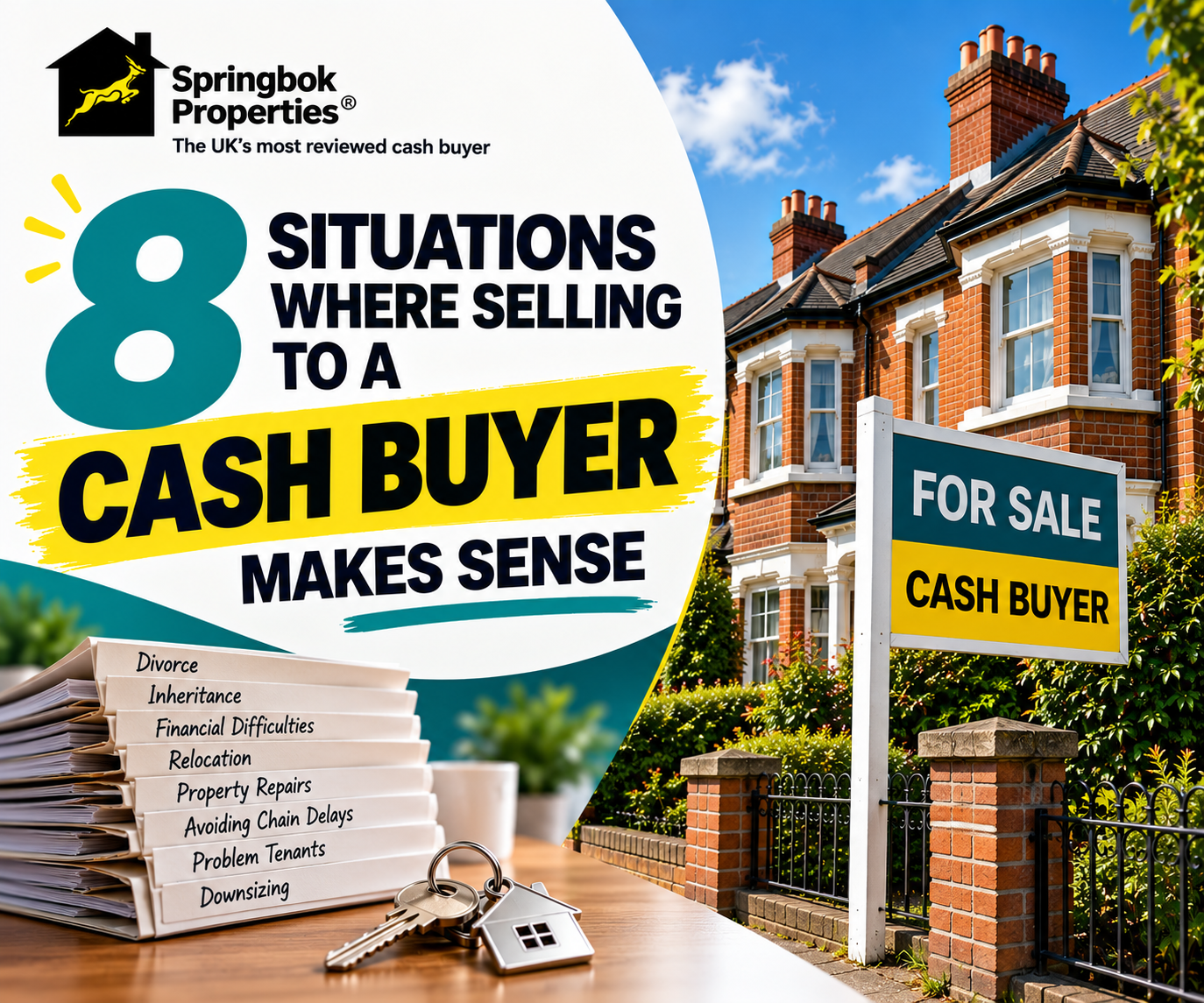
When something other than price is the binding constraint. Almost every seller would take full market value if the only variable were money — the question is what else is at stake. A court date, a completion date on another purchase, a tenant, a probate estate that needs distributing, or a property no lender will touch all change the arithmetic. The eight situations below are the ones where they usually change it decisively.
| Situation | The constraint | Why cash helps |
|---|---|---|
| 1. Probate or inherited property | An empty house costing money while an estate waits | Completes as soon as the grant is issued |
| 2. Divorce or separation | A clean financial split on a fixed timetable | A known figure on a known date |
| 3. Relocation or emigration | A job or visa start date you cannot move | No need to manage a sale from abroad |
| 4. A broken chain | Your onward purchase is about to collapse | Replaces the missing buyer within days |
| 5. Landlord exit | Tenants in situ narrow the buyer pool sharply | Many cash buyers purchase tenanted |
| 6. An unmortgageable property | No lender will finance it, so most buyers cannot buy | Cash needs no valuation or lender |
| 7. Arrears or financial pressure | A deadline set by a lender or a court | Clears the debt before the deadline |
| 8. A house that will not sell | Months of viewings with no offer | Ends the carrying costs and the uncertainty |
1. You have inherited a property you do not want to hold
An inherited house is usually empty, often unmodernised, and always costing somebody money. Insurance on an unoccupied property is more expensive and more restrictive, council tax exemptions run out, and the estate cannot be distributed until the property is dealt with. Where several beneficiaries are involved, a fixed completion date is often worth more than a theoretical extra few thousand pounds that requires everyone to agree and wait.
You can market and agree a sale while probate is pending, but you cannot complete until the grant is issued. Our guide to selling an inherited or probate property sets out the order to do things in.
2. You are separating and need a clean split
A divorce settlement needs a number and a date. An open-market sale gives you neither for months, and every month of delay keeps two people financially entangled and often living somewhere they would rather not be. A cash sale converts the house into a known sum on a known day, which is precisely what a consent order or financial settlement needs. Take independent legal advice on how the proceeds should be divided before you commit to any sale.
3. You are relocating or emigrating to a deadline
A job start date, a visa, or a school term does not move because a buyer’s solicitor is slow. Selling remotely is the harder problem: managing viewings, surveys, enquiries and a chain from another country or another end of the UK is genuinely difficult, and the sale is at its most fragile exactly when you are least able to intervene. Completing before you go removes the whole category of risk.
4. Your chain has broken and your purchase is at risk
This is the situation where the arithmetic is most obviously in favour of a fast sale, because the alternative is not a slower sale — it is losing the house you are buying, along with the survey, the mortgage arrangement fee and the abortive legal costs. With 23.7% of agreed sales collapsing in the first quarter of 2026, a chain break is not an unlucky edge case. A cash buyer can step into the gap in days and let your purchase proceed.
5. You are a landlord exiting a tenanted property
A property with tenants in situ is close to unsellable on the open market: owner-occupiers cannot move in, and most residential lenders will not lend on it. That leaves investors, and investors are themselves a small and price-sensitive pool. Many cash buying companies will purchase with the tenancy in place, which means you keep receiving rent right up to completion instead of losing income while you serve notice and leave the property empty.
6. The property is unmortgageable
Some houses have no open market at all, because no lender will finance them. The usual causes are a lease under 70 years, structural movement or subsidence, no functioning kitchen or bathroom, non-standard construction such as concrete prefabs, Japanese knotweed within the boundary, or serious damp and timber decay. In each case the property can only be bought by someone paying cash, and the number of private cash buyers who will take on that work is small.
A discount is unavoidable here, but it is worth being precise about what you are comparing. The alternative is not full market value — it is either fixing the defect first, at your own cost and risk, or a very long wait for a private cash buyer who wants that specific project.
7. You are behind on the mortgage or under financial pressure
If a lender or a court has set a date, speed stops being a preference. Selling before repossession normally protects more of your equity, because a lender selling in possession adds its legal, insurance and agency costs to your debt.
Get free advice before you decide to sell. If debt is the reason you are considering this, speak to StepChange, National Debtline or Citizens Advice first. They are free and independent, and selling your home may not be the right answer — lenders can often extend the term, capitalise arrears or agree a reduced payment instead.
8. The house has been on the market for months with no offers
A property that has sat unsold for six months is usually telling you something about price, but by then the listing itself has become the problem: buyers read a long time on market as a defect and bid accordingly. Meanwhile the carrying costs continue. At some point the realistic comparison is not between a cash offer and the asking price, but between a cash offer and another six months of the same.
When does a cash sale not make sense?
Often. If none of the eight situations above applies to you, the open market will almost certainly pay you more, and you should use it. Specifically, do not sell to a cash buyer if:
- You have no deadline. Time is the only thing you are buying. If you are not short of it, you are paying for nothing.
- The house is mortgageable and in a moving market. A well-priced, chain-free freehold in a busy area will find a buyer in weeks.
- You are in or near negative equity. A below-market offer may not clear the mortgage at all, which creates a shortfall rather than solving anything.
- You have not tried a price reduction. If the house has not sold in three months, a realistic asking price is the cheaper experiment and costs you nothing to run.
How to check a cash buyer before you commit
Whichever situation you are in, the buyer needs checking. Confirm the company appears on the National Association of Property Buyers members list and The Property Ombudsman register rather than simply displaying the logos, ask for proof of funds before you take the property off the market, and refuse any agreement with an upfront fee or a lock-in clause. Our guide to whether these companies are legit and the breakdown of what fees you should expect cover the checks in full.
Springbok Properties Ltd (company no. 09045757) is regulated by The Property Ombudsman and a member of the NAPB. There are no fees, we cover the legal costs and there is no tie-in. To weigh the routes yourself, read cash buyer vs estate agent, the pros and cons of selling for cash and how much below market value cash buyers offer, or start at sell house fast.
Frequently asked questions about selling to a cash buyer
When is selling to a cash buyer a good idea?
When speed or certainty matters more than the last 15% of the price. The clearest cases are probate, divorce, relocation to a deadline, a broken chain, a tenanted property, an unmortgageable house, mortgage arrears, or a home that has not sold in months.
How much less will a cash buyer pay?
Typically 15% to 20% below market value, so an offer of around 80% to 85% according to the National Association of Property Buyers. Against that, there is no estate agent commission and, with a genuine buying company, no legal fees for you to pay.
Can you sell a house with tenants in it to a cash buyer?
Yes. Many cash buying companies purchase with the tenancy in place, which most residential lenders will not finance. You keep receiving rent up to completion rather than losing income while you serve notice and hold an empty property.
Is it worth selling to a cash buyer if the house needs work?
Often, because a property with structural problems, a short lease or no kitchen may be unmortgageable, which removes most ordinary buyers. The realistic comparison is not full market value but the cost and risk of doing the repairs yourself first.
When should you not sell to a cash buyer?
When you have no deadline, the property is mortgageable and the local market is active — the open market will pay more. Also avoid it if you are near negative equity, because a below-market offer may not clear the mortgage.
Written by Dan Green, Property Expert at Springbok Properties. Last updated 2 September 2026. General information, not legal or financial advice; offer ranges from the NAPB and fall-through data from TwentyEA, Q1 2026.
