Freephone 24/7 Call: 0800 068 4015






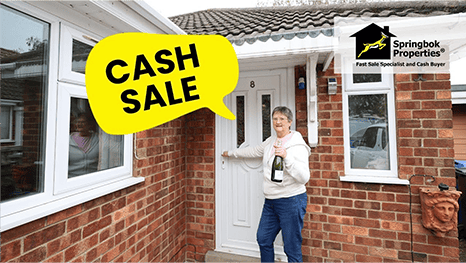

Cash House Buyers UK
Cash house buyers are companies or investors that buy your home directly with their own funds — no mortgage, no chain — completing in as little as 7 days. A genuine cash buyer pays around 75–85% of market value and is registered with the NAPB and The Property Ombudsman.
A cash house buyer trades some of your headline price for speed and certainty. Used well, it's the fastest, most reliable way to sell in the UK; used carelessly, it's where the quick-sale sector's scams live. This is the complete, honest 2026 guide — what cash buyers are, the different types, how much they really pay and why, the pros and the cons, how to spot a genuine one, and how Springbok compares.
Key takeaways
- A cash house buyer uses its own funds to buy directly, so there's no mortgage, no chain and no risk of the sale falling through.
- Genuine buyers pay around 75–85% of market value. Be wary of anyone promising much more — a straight cash offer of 90%+ usually isn't real.
- The sector is largely unregulated: the NAPB and The Property Ombudsman are voluntary schemes, not statutory regulators — but membership still gives you genuine recourse.
- Always check proof of funds, NAPB/TPO membership and Companies House, and confirm the offer is fixed in writing before you proceed.
- If you need closer to full value and aren't in a rush, Springbok's Fixed Price™ marketed route can achieve up to 95% with zero fees.
- Springbok is an NAPB member, regulated by The Property Ombudsman, has helped 19,000+ homeowners since 2012, and covers all legal and survey costs.
What are cash house buyers?
A cash house buyer is a company or individual that purchases property outright with funds already available, rather than relying on a mortgage. Because there's no lender and no onward purchase, they can buy chain-free and complete far faster than an open-market sale — often in one to three weeks. The trade-off is price: they pay below market value in return for that speed and certainty.
You'll see the same idea advertised as a "quick house sale company", a "we buy any house" service, or simply "sell your house fast for cash". The important distinction is between a firm that buys your house with its own money and one that only promises to sell it for you — more on that below.
What are the different types of cash house buyer?
"Cash buyer" covers several very different operators, and knowing which you're dealing with tells you how genuine, fast and safe the sale will be.
| Type | Who they are | Typical offer | Notes |
|---|---|---|---|
| Professional cash-buying company | Buys directly with its own funds | ~75–85% | The genuine article. Look for NAPB + TPO membership; covers your fees. |
| Individual property investor | A local investor buying to let or refurbish | Up to ~90% | Can pay more, but less regulated — do extra due diligence. |
| Institutional / bulk investor | Large funds buying in volume | ~70–80% | Usually for portfolios; slower (4–12 weeks). |
| iBuyer | Tech-led firm making instant algorithm offers | Near market value, minus a service fee | Rare in the UK; strict property criteria; you pay a fee. |
| Broker / lead-generator | Not a buyer — sells your details on | N/A | Red flag. Slow, uncertain, and a common source of scams. |
Springbok is a genuine, direct cash-buying company — we buy with our own funds and are NAPB-registered — and we also run a marketed route for sellers who want a higher price (see below).
How do cash house buyers work?
The process is deliberately simple, and a genuine buyer does the heavy lifting. It usually runs in five stages:
- Enquiry and offer in principle. You share your postcode and details; the buyer researches comparable sales and makes an initial cash offer, often within 24 hours.
- Survey and valuation. They confirm the market value — typically using HM Land Registry sold data and, for a reputable buyer, an independent RICS valuation.
- Formal offer. You receive a firm offer. A genuine buyer's figure shouldn't drop later unless something material is discovered.
- Solicitors and contracts. Legal checks are carried out (a reputable buyer covers these), then contracts are exchanged — the legally binding point.
- Completion. On your chosen date the sale completes and funds are transferred to your account, with any mortgage settled from the proceeds.
How much do cash house buyers pay?
Genuine cash buyers pay around 75–85% of market value, with the exact figure depending on the property and how quickly you want to complete. That's the price of speed, certainty and zero fees.
| Property / situation | Typical cash offer |
|---|---|
| Standard urban home in good order | Up to ~85% |
| Rural or harder-to-resell home | ~80% |
| Flats and apartments | ~75% |
| Problem / unmortgageable properties | ~75% |
| Bulk / portfolio (institutional buyers) | ~70–80% |
Why do cash buyers offer below market value?
The discount reflects the risk and cost the buyer takes on. They pay your legal and survey fees, tie up their own capital, and carry the risk of reselling — usually within about 90 days — in a market that can move. In effect you're paying for a guaranteed, fee-free, chain-free sale on a date you choose. Reputable buyers make a relatively small margin (often only 2–8% per property) by reselling to their investor network or at auction.
What are the pros of selling to a cash house buyer?
For the right seller, the benefits are substantial and go well beyond speed:
- Speed. Completion in as little as 7 days, versus around five months on the open market.
- Certainty. A genuine buyer's funds are ready, so there's no chain and effectively no risk of the sale collapsing.
- Any condition. They buy as-is — structural issues, damp, short leases and unmortgageable homes included.
- No fees. No estate agent commission, and your legal and survey costs are covered.
- No viewings or boards. A private sale with no strangers traipsing through your home.
- You choose the date. Complete around your move, not the market's timetable.
What are the cons of selling to a cash house buyer?
An honest guide has to cover the downsides too — a cash sale is not right for everyone:
- You accept below market value. Typically 15–25% less than a full open-market price.
- The sector is poorly regulated. The NAPB and The Property Ombudsman are voluntary schemes with no statutory enforcement power, so due diligence is on you.
- Scams exist. Last-minute price drops, brokers posing as buyers and untraceable companies are all real risks.
- "No fees" isn't "no cost". The discount to market value is the cost — just bundled into the price.
- Not for price-maximisers. If getting the highest figure matters more than speed or certainty, the open market is the better route.
Are cash house buyers legit? How to spot a genuine one
Genuine cash house buyers are entirely legitimate — but because the industry is largely unregulated, the responsibility to check falls on you. The Office of Fair Trading's 2013 market study exposed under-valuations and last-minute price cuts, which is why the NAPB and The Property Ombudsman introduced voluntary standards. Run these checks before you accept any offer:
- NAPB and TPO membership. Verify it directly with the National Association of Property Buyers and The Property Ombudsman — this gives you a redress route if things go wrong.
- Proof of funds. A real cash buyer can evidence the money to complete. No proof, no deal.
- Companies House. Check the company on Companies House — incorporation date, filed accounts and named directors.
- Direct buyer, not a broker. Ask in writing whether they buy themselves or pass you to a third-party investor.
- A fixed offer. Get written confirmation the price won't be cut after the survey.
- Independent reviews. Look for volume and recency on Trustpilot and Google, not just a headline rating.
Red flags that signal a scam:
- Any request for upfront or "valuation" fees.
- An offer that drops at the last minute, when your options are limited.
- Pressure to sign an "option agreement" that lets them market your home rather than buy it.
- No proof of funds, no NAPB/TPO membership, no real office, or reviews you can't verify.
What questions should you ask a cash house buyer?
Six questions quickly separate a genuine buyer from a time-waster:
- Are you the direct buyer, or a broker passing me on?
- Can you show proof of funds?
- Are you a member of the NAPB and registered with The Property Ombudsman?
- Is your offer fixed, or can it change before completion?
- Who pays the legal and survey costs?
- Can I withdraw at any point with no penalty?
Cash house buyers vs estate agents vs auction: the full comparison
A cash buyer is one of six realistic ways to sell. Here's how they compare on the things that matter — time, price, cost and certainty.
| Method | Timeframe | Price achieved | Seller fees | Certainty |
|---|---|---|---|---|
| Cash house buyer | 7–28 days | 75–85% | £0 (covered) | High |
| Traditional auction | 2–4 months | 75–90% (variable) | 2–3% + entry | Medium |
| Modern method of auction | 3–5 months | 75–90% | Usually buyer-paid premium | Medium |
| Online estate agent | 4–7 months | 85–100% | Fixed £500–£1,500 | Low |
| High-street estate agent | ~5–9 months | 90–100% | 1–3% + VAT | Low |
| Assisted / Fixed Price™ sale | 28–42 days (Springbok) | Up to 95% | £0 with Springbok | Medium–High |
The pattern is consistent: the faster and more certain the route, the lower the headline price — with Springbok's Fixed Price™ route offering a genuine middle ground. Compare the fastest options in our sell house fast guide.
When should you use a cash house buyer?
A cash sale makes most sense when certainty and speed are worth more than the last few percent of price. Common situations include:
Broken chain
Rescue an onward purchase when your buyer pulls out.
Repossession
Complete before a court order and protect your equity. More →
Inherited / probate
Release equity and stop the running costs. More →
Divorce or separation
A clean split on a settlement-driven timeline. More →
Relocation / emigration
Sell a UK home to a fixed deadline, remotely.
Problem property
Structural issues, short lease or unmortgageable — sold as-is.
How does Springbok compare as a cash house buyer?
Springbok Properties Ltd (company no. 09045757, Manchester) is a genuine, direct cash buyer — and, unusually, we give you a choice of routes rather than one take-it-or-leave-it figure. We're an NAPB member, regulated by The Property Ombudsman, and have helped more than 19,000 homeowners since 2012, with 11,700+ independent reviews and seven gold awards for customer service.
Springbok Fast Cash™
~80% of market valueOur quickest route when a deadline can't move. Learn more →
Springbok Fixed Price™
Up to 95% of market valueA marketed sale through our buyer network — not a straight cash offer, but a higher price with zero fees. Learn more →
You can check our cash buyer company reviews and verified seller reviews, or read whether Springbok is a legitimate business, before you decide.
How does selling to Springbok work, step by step?
You can start with nothing more than your postcode — no viewings, no staging, no upfront paperwork.
- Get your free cash offer. Share your postcode and details; we research comparable sales and Land Registry data and make a free, no-obligation offer, often the same day.
- Choose your route and date. Pick Cash Sale™, Fast Cash™ or Fixed Price™ and the completion date that suits you.
- We instruct solicitors and survey. We appoint solicitors and arrange any survey at our cost — you pay nothing.
- Complete and get paid. On your chosen date the sale completes and funds land in your account.
How do you protect yourself from cash-buyer fraud?
Beyond checking the buyer is genuine, three free steps protect the transaction itself:
- Register for HM Land Registry Property Alert — free monitoring of up to 10 properties, with email alerts on suspicious activity.
- Verify solicitor bank details by phone — using an independently checked number, never one taken from an email alone.
- Report anything suspicious to Action Fraud, the UK's national fraud reporting centre.
Cash house buyers: key terms explained
- Cash buyer
- A buyer with funds already available who doesn't need a mortgage, so can complete quickly and chain-free.
- Cash-buying company
- A business that buys homes directly for cash, usually completing in days or weeks and covering the seller's legal costs.
- iBuyer
- A technology-led company that makes instant, algorithm-based offers near market value but charges a service fee; uncommon in the UK.
- Proof of funds
- Evidence a buyer genuinely holds the money to complete — the single most important check on any cash buyer.
- Offer in principle
- An initial estimated offer made before any survey; the formal post-survey offer is the figure that counts.
- Option agreement
- A contract giving a company the right to market or buy your home later; sometimes mis-sold by firms posing as buyers.
- Gazundering
- When a buyer lowers their offer just before exchange, when the seller is most exposed.
- Modern method of auction
- An online auction with a longer completion window (often 56 days) and a buyer-paid reservation fee.
- Assisted sale
- A route where a company markets and sometimes improves your home so it sells nearer full value; slower than a straight cash sale.
- Proof of ownership / title deeds
- Documents held at HM Land Registry that prove you own the property.
- Capital Gains Tax (CGT)
- Tax on the gain when selling a property that isn't your main home, such as a buy-to-let or second home.