
 Freephone 24/7 Call: 0800 068 4015










I'm a property expert that still remembers the days when having broadband was a selling point! My articles cover issues that homesellers face in the UK and answer the questions we're all asking. I've bought and sold properties and helped others do the same, so my writing comes from years of experience.
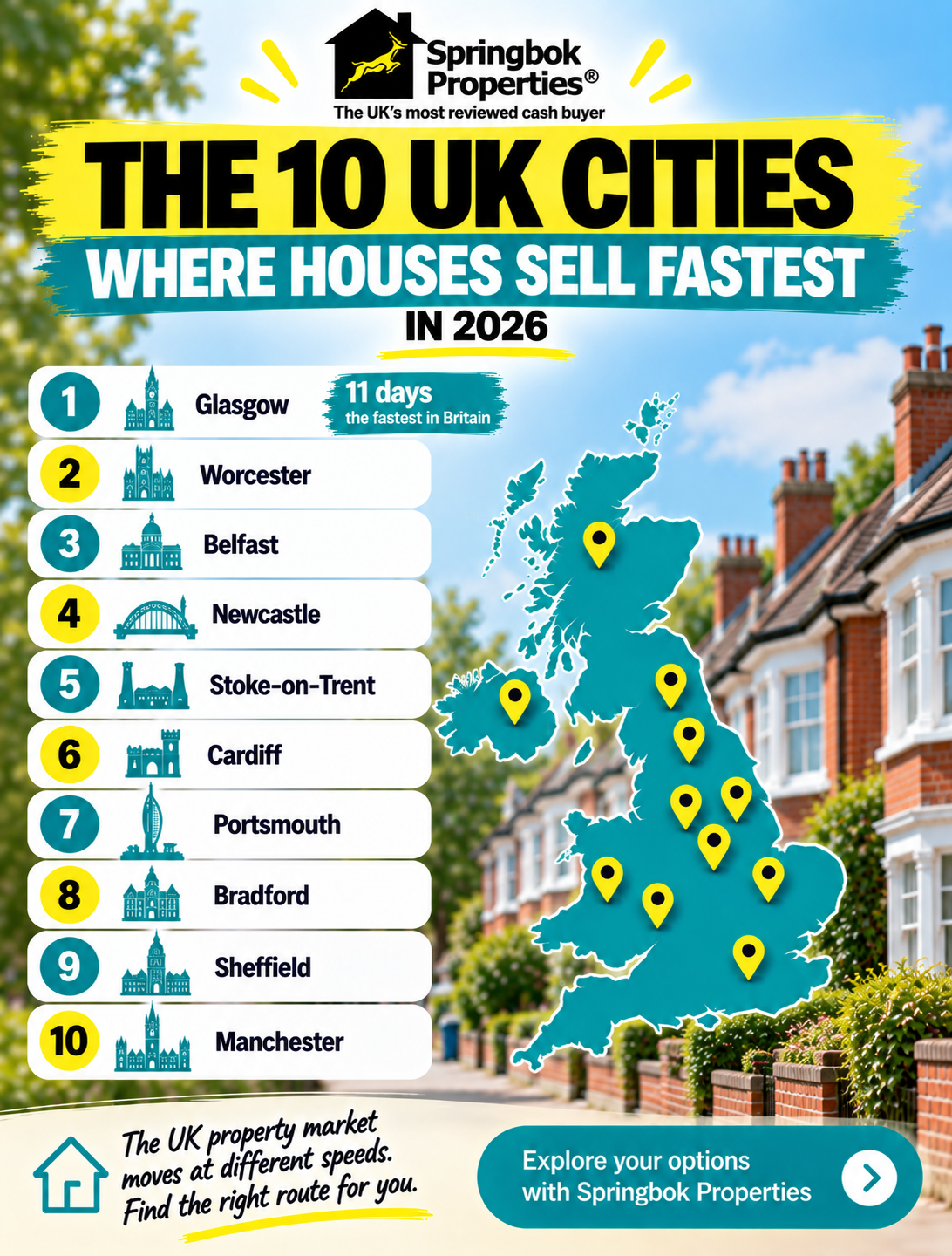
Read Full Bio >Glasgow is the fastest-selling city in the UK, where homes agree an offer in an average of 11 days — against a UK average of 30 days. Worcester and Belfast follow, both typically under two weeks.
Key takeaways
- Glasgow is the UK’s fastest-selling city at 11 days to agree an offer, according to Alto’s Speed of Sale Index published in August 2026, which draws on data from more than 6,000 UK estate agents.
- The UK average is 30 days to agree an offer. London matches that average exactly and ranked 21st of the cities analysed.
- Wakefield is the slowest-selling UK city at 63 days — twice the national average and six times longer than Glasgow.
- Property type can matter more than postcode. Terraced and semi-detached homes agree an offer in 26 days nationally; flats now take 39 days, up 34% year on year.
- “Days to sell” means days to agree an offer, not days to get paid. A freehold sale then takes a further 12–16 weeks to complete, and around 24% of agreed sales collapse before completion.
Which UK cities sell houses fastest in 2026?
The ten fastest-selling cities in the UK are Glasgow, Worcester, Belfast, Newcastle, Stoke-on-Trent, Cardiff, Portsmouth, Bradford, Sheffield and Manchester. The ranking comes from the Alto Speed of Sale Index, published in August 2026 using transaction data from over 6,000 estate agency branches.
Two things stand out. The first is how far ahead Glasgow sits: 11 days is not a narrow win, it is roughly a third of the national average. The second is that the list is dominated by regional cities with accessible price points rather than by the expensive South East — London only managed the UK average of 30 days and ranked 21st.
| Rank | City | Region | Time to agree an offer |
|---|---|---|---|
| 1 | Glasgow | Scotland | 11 days — the fastest in Britain |
| 2 | Worcester | West Midlands | Under two weeks |
| 3 | Belfast | Northern Ireland | Under two weeks |
| 4 | Newcastle | North East | Faster than the 30-day UK average |
| 5 | Stoke-on-Trent | West Midlands | Faster than the 30-day UK average |
| 6 | Cardiff | Wales | Faster than the 30-day UK average |
| 7 | Portsmouth | South East | Faster than the 30-day UK average |
| 8 | Bradford | Yorkshire | Faster than the 30-day UK average |
| 9 | Sheffield | Yorkshire | Faster than the 30-day UK average |
| 10 | Manchester | North West | Faster than the 30-day UK average |
Alto published exact day counts for Glasgow (11 days), the UK average and London (30 days) and Wakefield (63 days); the remaining cities were released as a ranked order rather than as individual figures, so we have not invented numbers for them.
Why does Glasgow sell so much faster than everywhere else?
Glasgow’s lead is the product of two separate advantages: a genuinely tight local market, and the Scottish conveyancing system.
On the local side, Alto’s chief executive Riccardo Iannucci-Dawson attributed it to accurate pricing rather than frenzy, noting that homes priced for what local buyers will actually pay move, while homes priced for what the seller hoped for 18 months ago sit. Glasgow agents also point to a chronic undersupply of property at accessible price points.
On the system side, selling a house in Scotland works differently from England and Wales. Scottish sellers must commission a Home Report — a single survey, energy report and property questionnaire — before the property goes on the market, so buyers see the survey before they offer rather than three weeks after. Scottish offers also become binding at the conclusion of missives, far earlier than exchange of contracts south of the border. Both remove delay, and both remove the survey renegotiation that stalls so many English sales.
Worth knowing: survey problems are the single biggest cause of UK sales collapsing, accounting for 37.5% of fall-throughs in early 2026. Scotland largely front-loads that risk, which is a big part of why Scottish cities cluster at the top of speed rankings.
Which UK cities take the longest to sell?
Wakefield is the slowest-selling city in the UK at 63 days to agree an offer — twice the national average. The ten slowest cities in Alto’s August 2026 index, in order from slowest, are:
- Wakefield
- Swansea
- Peterborough
- Nottingham
- York
- Lincoln
- Chester
- Cambridge
- Wolverhampton
- Leicester
It is worth noticing what this list is not. It is not a list of cheap or unwanted places — Cambridge, York and Chester are among the most desirable markets in the country. Slow does not mean unsellable; it usually means a narrower pool of buyers at the price being asked, more chain-dependent purchasers, or a mismatch between asking prices and what lenders will support.
Does property type matter more than the city?
Frequently, yes. The gap between the fastest and slowest property types is wider than the gap between most cities, which means a flat in Glasgow can easily take longer to sell than a terraced house in a mid-table city.
| Property type | Days to agree an offer | Why |
|---|---|---|
| Terraced and semi-detached | 26 days | The quickest-selling property types nationally |
| UK average, all types | 30 days | The national benchmark for agreeing an offer |
| Flats and apartments | 39 days | Up 34% in 12 months, from 29 days |
| Detached houses | 41 days | Smaller buyer pool at higher price points |
| One-bed and studio homes | 42 days | Up 31% in 12 months, from 32 days |
| Park and mobile homes | 96 days | Specialist buyers and limited lending |
| Retirement and sheltered housing | 98 days | The slowest-selling property type in the UK |
The flat figure is the one to watch. At 39 days, flats now take 34% longer to sell than they did a year earlier, when the figure was 29 days. One-bed and studio properties have moved the same way, from 32 to 42 days. If you own a leasehold flat, the city you are in is probably the least important variable in your timeline.
What “30 days to sell” actually means
Every figure on this page measures the time from listing to agreeing an offer. It does not measure the time until you have the money, and the difference is substantial.
After an offer is accepted, a freehold sale in England and Wales typically takes a further 12–16 weeks to reach completion; leasehold sales commonly run to 16–20 weeks. So a home that sells in a “fast” 30 days is still realistically four to five months from completion. Our guide to how long it takes to move once an offer is accepted breaks that second half down stage by stage.
There is also the question of whether the sale survives at all. Around one in four agreed UK sales fails before completion — TwentyCi recorded a fall-through rate of 23.7% in the first quarter of 2026. Survey issues (37.5%) and buyers changing their minds (31.25%) were the leading causes, with chain breaks and lending problems accounting for 12.5% each.
How to sell fast even in a slow city
Location sets the baseline, not the outcome. These are the levers that actually move the timeline, in the order they matter:
- Price to the evidence on day one. The first two weeks generate the most viewings a listing will ever get. A property that is reduced twice over three months usually ends up selling for less than one priced correctly at the start.
- Get the paperwork ready before you list. Title deeds, the EPC, FENSA certificates, building regulations sign-offs and any guarantees. Missing documents routinely add weeks during conveyancing.
- Pre-empt the survey. Damp, roof and structural issues are the most common deal-breakers. Knowing about a problem before a buyer’s surveyor finds it lets you price it in rather than renegotiate under pressure.
- Reduce chain risk. Chain-free buyers, or buyers with a sale already agreed and a mortgage in principle, complete far more reliably than the highest bidder with a house still to sell.
- Consider a route that skips the open market. A genuine cash buyer can exchange without a mortgage, a chain or a survey renegotiation.
That last option is where Springbok fits. We are a member of the National Association of Property Buyers and regulated by The Property Ombudsman, and we buy in every city on both lists above — including Glasgow, Manchester, Leeds and Liverpool. The trade-off is honest and worth understanding before you start: a cash sale buys certainty and speed, and in exchange the offer sits below full market value. Our comparison of a cash buyer versus an estate agent sets out both routes side by side, and the sell house fast guide covers every option in between.
Frequently asked questions
Which UK city sells houses the fastest?
Glasgow. Alto’s Speed of Sale Index, published in August 2026, found Glasgow homes agree an offer in an average of 11 days — roughly three times faster than the UK average of 30 days, and six times faster than Wakefield at 63 days.
How long does it take to sell a house in the UK on average?
The UK average is 30 days to agree an offer, according to Alto’s August 2026 data drawn from more than 6,000 estate agents. Getting from an accepted offer to completion then usually adds 12–16 weeks for a freehold sale, or 16–20 weeks for leasehold.
Why do houses sell faster in Scotland?
Scotland uses a different system. Sellers must provide a Home Report — a survey, energy report and property questionnaire — before marketing, so buyers see the survey up front. Offers are also legally binding much earlier, which removes a large slice of the delay and uncertainty found in England and Wales.
Does the type of property matter more than the city?
Often, yes. Alto found terraced and semi-detached homes agree an offer in 26 days nationally, while flats take 39 days — up 34% year on year — and retirement or sheltered housing takes 98 days. A flat in a fast city can easily sell slower than a terrace in a slow one.
Can I sell quickly in a slow city like Wakefield?
Yes. Speed in a slow market comes from pricing to the evidence rather than to hope, presenting the property well, and removing chain risk. Selling to a genuine cash buyer bypasses the open market entirely, though you should expect an offer below full market value in return for the certainty.
Is a fast sale the same as a completed sale?
No. The figures above measure the time to agree an offer, not to get the money. Around 24% of UK sales agreed still collapse before completion — TwentyCi recorded 23.7% in the first quarter of 2026 — so an offer agreed in 11 days is not the same as a sale that finishes.
Written by Dan Green, Springbok Properties. Last updated 13 September 2026. Speed-of-sale figures: Alto Speed of Sale Index, August 2026. Fall-through figures: TwentyCi, Q1 2026. Springbok Properties Ltd is a member of the NAPB and regulated by The Property Ombudsman.
