
 Freephone 24/7 Call: 0800 068 4015










I'm a property expert that still remembers the days when having broadband was a selling point! My articles cover issues that homesellers face in the UK and answer the questions we're all asking. I've bought and sold properties and helped others do the same, so my writing comes from years of experience.
Read Full Bio >A “we buy any house” company buys your home directly with its own cash. You give the address, it values the property remotely, offers roughly 75%–85% of market value, and completes in 7–28 days with no fees.
Key takeaways
- The process has six stages — enquiry, desktop valuation, formal offer, survey, conveyancing, completion — and a genuine buyer can move from first call to money in your account in 7 to 28 days.
- You pay nothing. A real cash buyer covers your legal fees and the valuation, and charges no commission. Its profit comes entirely from the discount, typically 75%–85% of market value.
- On a £200,000 home, that discount is worth roughly £30,000–£50,000 — the price of speed, certainty and a guaranteed buyer.
- The single biggest risk is not the discount but the offer being cut just before exchange. Ask, in writing, how often the company revises its offer after survey before you commit.
- Not every site advertising “we buy any house” is a buyer — many are lead generators that sell your details on. Check the company is a member of the National Association of Property Buyers (NAPB) and registered with The Property Ombudsman (TPO).
How does “we buy any house” work, step by step?
A “we buy any house” sale replaces the open market entirely. Instead of listing the property, waiting for a buyer and hoping their chain holds, you sell to a company that already has the money and is buying the house for its own book. That removes the three things that make normal sales slow: marketing time, mortgage approval, and the chain.
The mechanics are the same at almost every reputable UK firm:
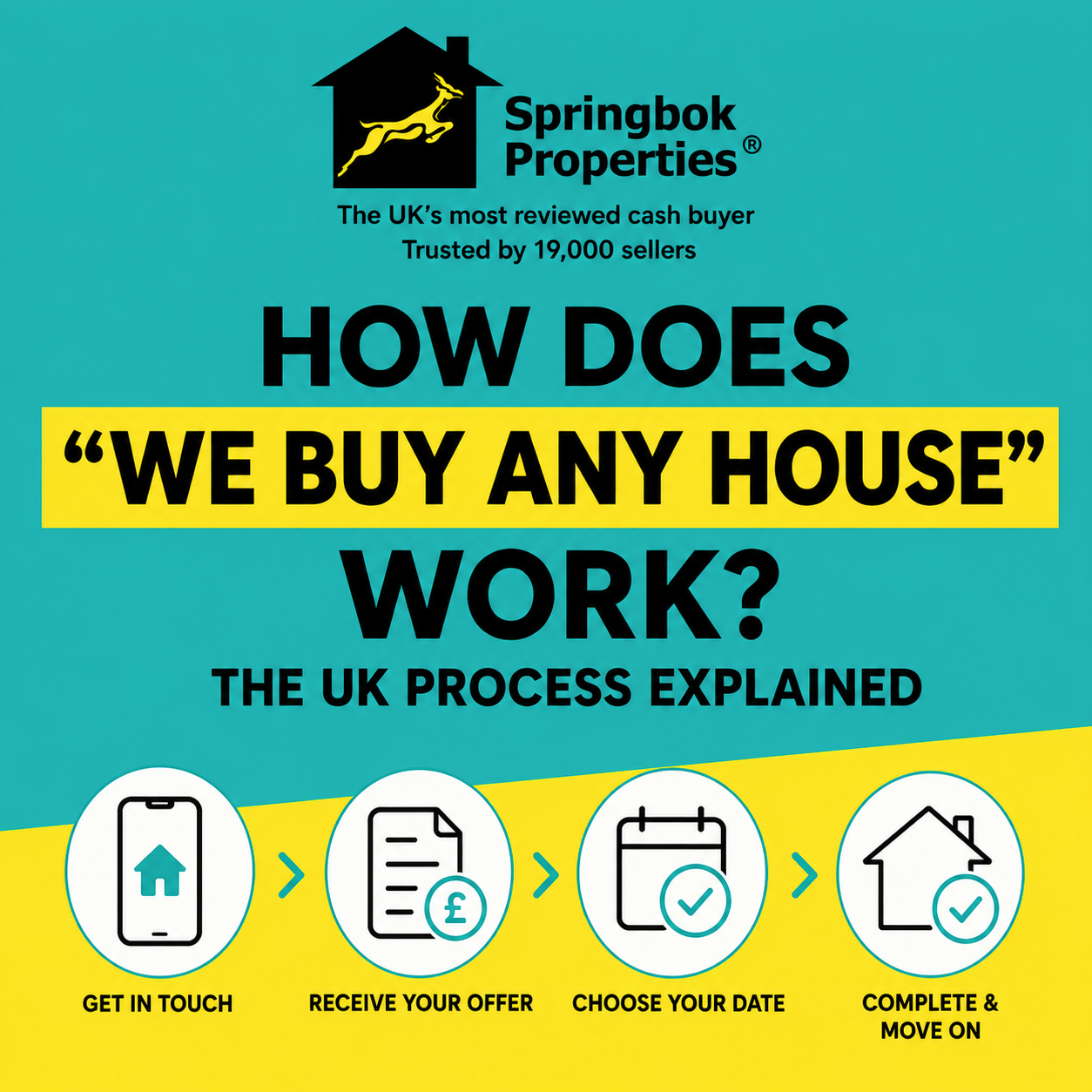
- Initial enquiry (day 0). You give the address, property type, rough condition and your reason for selling, either through an online form or by phone. No viewing is needed at this stage, and there is no obligation.
- Desktop valuation (day 0–2). The company values the property using HM Land Registry sold-price data, current listings for comparable homes nearby, and how long similar properties are taking to sell in your postcode. Better firms also ring two or three local estate agents for a real-world view.
- Cash offer (day 1–3). You receive a figure, expressed as a percentage of the assessed market value. It should be free, in writing, and valid for a stated period. You are under no obligation to accept it.
- Survey or inspection (day 3–10). If you accept in principle, the buyer instructs a survey — usually by an independent RICS surveyor — to confirm condition and check for anything that would change the figure, such as damp, subsidence or non-standard construction.
- Conveyancing (day 5–21). Both sides instruct solicitors. The buyer normally pays your legal costs. Your solicitor carries out searches, handles anti-money-laundering ID checks and confirms the buyer’s proof of funds. This is the stage that actually sets the pace.
- Exchange and completion (day 7–28). Contracts exchange, a completion date is fixed to suit you, and on completion the funds are sent to your solicitor, who redeems any mortgage and pays the balance into your bank account.
The whole thing is a normal property sale, legally speaking — the same contracts, the same searches, the same Land Registry transfer. What changes is that the buyer is a company with cash rather than a household with a mortgage offer.
How long does a “we buy any house” sale take?
Seven to twenty-eight days from accepted offer to completion is the realistic range in 2026, against roughly 16 to 24 weeks for a typical open-market sale. Conveyancing is the bottleneck, not the buyer: the money is already there, so the timetable is set by searches, ID checks and how quickly your solicitor works.
| Stage | Cash sale | Estate agent sale |
|---|---|---|
| Valuation to offer | 1–3 days | 2–12 weeks (find a buyer) |
| Survey | 3–10 days | 2–4 weeks (mortgage survey) |
| Mortgage approval | Not required | 3–6 weeks |
| Conveyancing | 1–3 weeks | 8–12 weeks |
| Chain risk | None | Yes |
| Total, typical | 7–28 days | 16–24 weeks |
Speed is only half the point. Around one in four agreed UK property sales collapses before completion — most often because a buyer’s mortgage falls through or someone further down the chain pulls out. A cash purchase removes both of those failure modes, which is why sellers facing a deadline, a repossession hearing or a broken chain use one. If certainty matters more than timing, that is the number to weigh.
How is the cash offer calculated?
The offer is a percentage of assessed market value, and the percentage moves with how easily the buyer expects to resell. Most genuine UK offers land between 75% and 85%. A modern three-bed semi in a busy postcode sits at the top of that band; a leasehold flat with a short lease, cladding issues or structural problems sits at the bottom, and some properties are declined outright.
Four things move the number:
- Resale speed. The buyer’s capital is tied up until it sells the house on. A property that will shift in six weeks earns a better offer than one that will sit for six months.
- Condition. Refurbishment cost comes straight off the offer, usually at trade prices plus a contingency.
- Saleability. Anything that limits the pool of onward buyers — unmortgageable construction, a lease under 80 years, Japanese knotweed, subsidence history — widens the discount.
- Your timescale. A seven-day completion costs the buyer more in legal and funding terms than a 28-day one, and that can show up in the figure.
We break the arithmetic down in full in our guide to how much below market value cash buyers offer. The short version: on a £200,000 home, an offer at 82% is £164,000, so the discount is £36,000 — but an estate agent sale at the full asking price nets about £194,800 after fees, and only if it completes at all.
Is it free, and who pays the legal fees?
A genuine “we buy any house” company charges the seller nothing — no valuation fee, no admin fee, no commission — and pays your conveyancing costs if you use its recommended solicitor. It is the buyer in the transaction, and buyers do not invoice sellers. Its entire margin is in the discount.
That is why an upfront charge of any kind is the clearest warning sign in this market. Our detailed breakdown of “we buy any house” fees covers the exceptions and the small print worth reading.
Who is actually buying your house?
Not every website advertising “we buy any house” buys houses. There are three distinct business models behind the same phrase, and they behave very differently once you hand over your details.
| Type | What they do | What it means for you |
|---|---|---|
| Principal cash buyer | Buys with its own funds and owns the property | One point of contact, no fees, offer is theirs to honour |
| Lead generator | Collects enquiries and sells them to investors | Multiple callers, no guaranteed buyer, possible introduction fee |
| Assisted / brokered sale | Markets your home to its buyer network at a higher price | More money, longer timescale, less certainty than a cash offer |
All three can be legitimate. The problem is being sold one while believing you are getting another. Three checks settle it in about ten minutes:
- Companies House. Look up the registered company, its filing history and how long it has traded. Springbok Properties Ltd, for example, is company number 09045757.
- NAPB and TPO. Members of the National Association of Property Buyers must also register with The Property Ombudsman, which gives you free, independent redress if something goes wrong. This is the sector’s self-regulation, formed after the Office of Fair Trading’s 2013 study into quick house sales.
- Proof of funds. Ask for it before you accept. A real cash buyer will produce bank statements or a solicitor’s undertaking without hesitating.
What can go wrong?
The most common complaint in this sector is not the size of the original offer — it is the offer being cut days before exchange, when the seller is committed and has no time to start again. Ask directly, before you accept: how many of your purchases complete at the original offer price?
Red flags to walk away from
- Any fee or charges requested before completion, however it is labelled.
- An offer made without any valuation, then reduced after survey by more than a few percent.
- Pressure to sign quickly, or an offer that “expires today”.
- Refusal to name the buying entity or provide proof of funds.
- Being asked to use their solicitor with no option to instruct your own.
Two further protections cost nothing. Register for HM Land Registry’s free Property Alert service, which emails you if anyone applies to change the register on your property. And keep your own solicitor’s advice independent — you are entitled to instruct whoever you like, even when the buyer is paying. For a fuller list of the warning signs, see “we buy any house” scams and red flags.
Is a “we buy any house” sale right for you?
It suits sellers for whom certainty is worth more than the last 15–20% of the price: people facing repossession, executors settling a probate estate, landlords exiting a tenanted portfolio, sellers whose chain has broken, and anyone with a property no mortgage lender will touch. It is a poor fit if you have six months, a saleable house and no pressure — in that case an estate agent will almost always net you more.
There is also a middle path worth knowing about. Springbok runs two routes: a fast cash purchase for speed, and a fixed-price assisted sale that markets the property to a buyer network for a higher figure over a slightly longer timescale. Sellers who are not on a hard deadline often do better on the second. Our comparison of cash buyer vs estate agent vs auction sets out all three side by side, and our We Buy Any House guide covers the full service.
Frequently asked questions
Do “we buy any house” companies really buy any house?
Most, but not all. Genuine cash buyers will purchase properties estate agents struggle with — non-standard construction, subsidence, short leases, tenanted or fire-damaged homes — because they are buying to hold or refurbish, not to mortgage. They can still decline a property if the resale route is unclear or the title is defective.
How much do “we buy any house” companies pay?
Typically 75% to 85% of open-market value, with most mainstream UK offers clustering around 80%. On a £200,000 home that is £150,000 to £170,000. The percentage depends on condition, location and how quickly the buyer expects to resell, not on how urgently you need to sell.
Can a “we buy any house” company reduce its offer?
Yes, and this is the main thing to guard against. An offer can legitimately fall after a survey reveals something material, such as damp or structural movement. It should not fall for no stated reason days before exchange. Get the company’s revision policy in writing before you accept.
Do I need my own solicitor?
Yes. Even when the buyer pays your legal fees, the solicitor acts for you and must be independent. You are entitled to instruct your own firm rather than the buyer’s recommendation, and a reputable buyer will not object if you do.
How quickly can I actually get the money?
Seven days is achievable when the title is clean, you are not in a chain and your solicitor moves quickly. Fourteen to twenty-eight days is more typical. Anything faster than seven days usually means searches have been skipped, which is a risk for the buyer rather than for you.
Is selling to a cash buyer safe?
It is as safe as any property sale provided the buyer is a principal with proof of funds, is an NAPB member registered with The Property Ombudsman, and you use your own solicitor. The transaction itself uses the same contracts and Land Registry process as any other sale.
