
 Freephone 24/7 Call: 0800 068 4015











I'm a property expert that still remembers the days when having broadband was a selling point! My articles cover issues that homesellers face in the UK and answer the questions we're all asking. I've bought and sold properties and helped others do the same, so my writing comes from years of experience.
Read Full Bio >A quick sale company buys your house in 7 to 28 days for roughly 75–85% of market value; a UK estate agent sale averages about five months, and nearly one in four fell through in early 2026.
Key takeaways
- Speed: a quick sale company completes in 7–28 days. An estate agent sale in England and Wales takes around 22 weeks (roughly five months) from listing to completion.
- Price: quick sale companies pay about 75–85% of open-market value. Estate agents chase full market value but charge 1–3% plus VAT in commission.
- Certainty: TwentyEA recorded a national fall-through rate of 23.7% in Q1 2026 — close to one in four agreed sales — and 38% of those collapses happen in the first four weeks.
- Regulation: estate agents must belong to a redress scheme by law. The quick sale sector is not regulated — membership of the NAPB and registration with The Property Ombudsman are voluntary, so check both yourself.
- The real trade: on a £250,000 home the gap between the two routes is typically £30,000–£40,000 once agent fees and five months of carrying costs are deducted — you are buying speed and certainty with that money.
What is the actual difference between a quick sale company and an estate agent?
An estate agent is a middleman: they market your property, find a buyer and take a percentage on completion. A quick sale company is the buyer: it purchases your house directly with its own funds, so there is no marketing, no viewings, no chain and no mortgage lender to satisfy.
That structural difference explains everything else. An agent reaches the whole market and gets you the highest price, but every step depends on a stranger’s mortgage, survey and solicitor. A quick sale company controls its own money and can commit to a completion date — while pricing in the discount and the risk it carries. “Quick sale company”, “cash house buyer” and “we buy any house” company all describe the same model; our guide to what it really means to sell a house for cash untangles the labels.
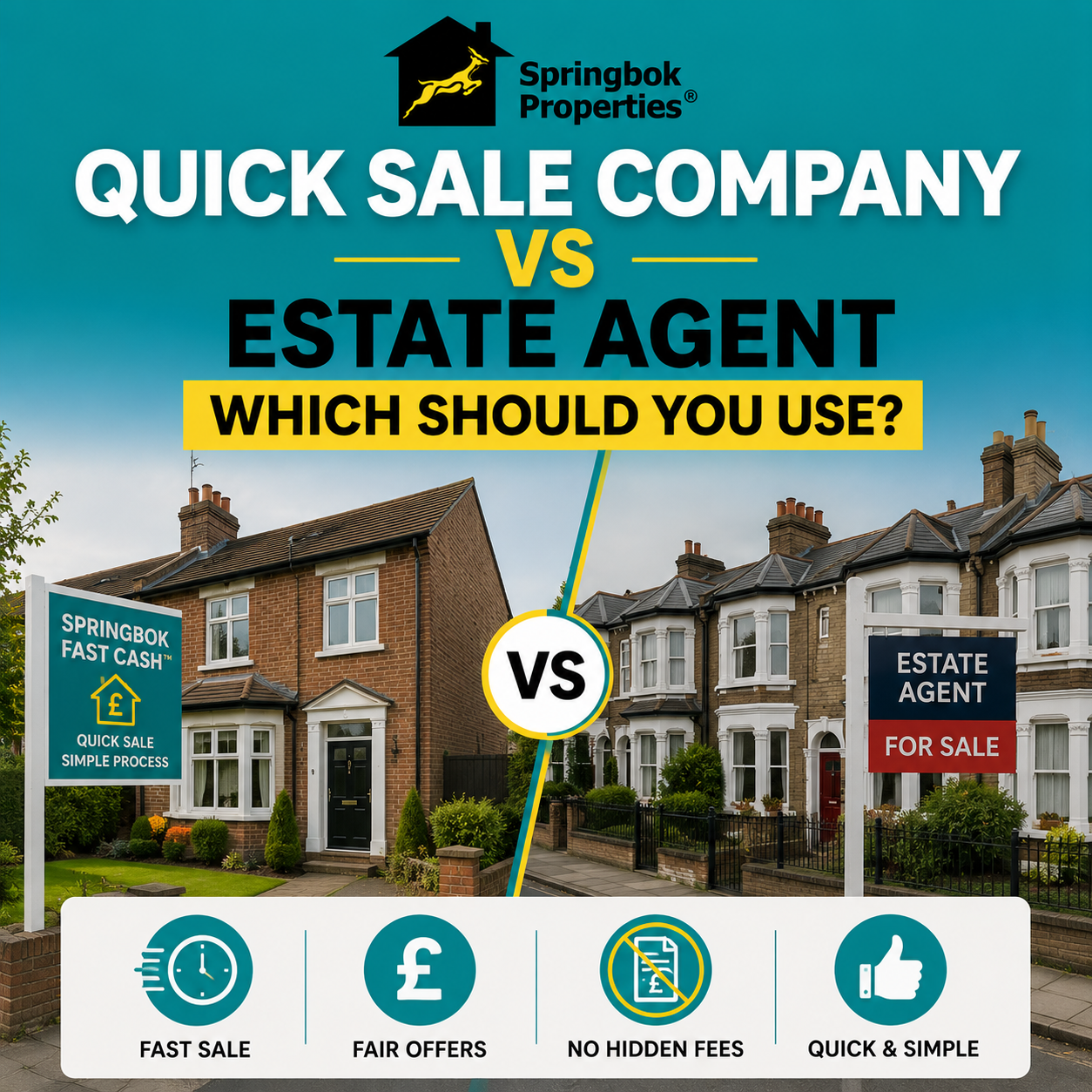
Quick sale vs estate agent: the at-a-glance comparison
The two routes optimise for opposite things. One maximises price, the other maximises speed and certainty.
| Factor | Quick sale company | High-street estate agent |
|---|---|---|
| Typical time to completion | 7–28 days | ~22 weeks (about 5 months) |
| Price achieved | ~75–85% of market value | Up to 100% of market value |
| Commission | None | 1–3% + VAT |
| Legal fees | Usually paid by the buyer | Paid by you (£1,000–£2,000) |
| Viewings | One valuation visit | Ongoing, open-ended |
| Chain risk | None — chain-free buyer | Inherits the buyer’s chain |
| Fall-through risk | Low — funds already held | ~24% of agreed sales collapse |
| Completion date | You choose it | Dictated by the chain |
| Regulation | Voluntary: NAPB / TPO | Mandatory redress scheme |
| Tie-in period | None, or very short | Typically 8–12 weeks |
How long does each route really take?
An estate agent sale in England and Wales takes roughly 22 weeks from listing to completion. A quick sale company can complete in 7 to 28 days because it removes the stages that consume most of that time.
A typical agent sale runs: two to four weeks of preparation, four to twelve weeks on the market finding a buyer, eight to sixteen weeks of conveyancing, then one to four weeks between exchange and completion. Zoopla puts the listing-to-sale-agreed stage alone at about 35 days nationally — and that is only the first milestone, not money in your account.
A quick sale skips all of it: no marketing period because the buyer is already found, no mortgage application because the purchase is funded from cash, no chain to wait on. What is left is a valuation, searches and the legal paperwork — which is why selling a house in seven days is achievable, though 14 to 28 days is more common. If you have a repossession hearing, a probate deadline or a purchase you will lose, five months is not a plan; our guide to how to sell a house fast sets out the timeline for each option.
What will you actually walk away with?
Compare net proceeds, not headline prices. An agent’s higher sale price is reduced by commission, legal fees and five months of running the property — but even after all that, the agent route normally still nets more. Here is the arithmetic on a £250,000 home, using a 1.5% + VAT agent fee and illustrative carrying costs of £900 a month for mortgage interest, council tax, utilities and insurance while it sits on the market.
| Line | Estate agent | Quick sale company |
|---|---|---|
| Sale price | £250,000 | £205,000 (82%) |
| Agent commission (1.5% + VAT) | −£4,500 | £0 |
| Conveyancing | −£1,500 | £0 (buyer pays) |
| EPC and marketing extras | −£120 | £0 |
| Carrying costs while selling | −£4,500 (5 months) | −£900 (1 month) |
| Net to you | £239,380 | £204,100 |
| Cash in your account | ~5 months | ~2–4 weeks |
The gap on this example is about £35,000, or 14% of the property’s value. Anyone who tells you a quick sale is “basically the same money” is not being straight with you. The honest framing is that you are paying roughly £35,000 for four months of your life back and a completion date you control.
Two figures move that gap. First, the discount: our breakdown of how much below market value cash buyers offer explains why 75–85% is the genuine range and why anything near 100% is usually an opening number designed to be cut later. Second, the fees: a legitimate company charges no fees at all, so any valuation, admin or reservation charge is really a reduction in the offer.
How likely is each sale to fall through?
TwentyEA recorded a national fall-through rate of 23.7% for the first quarter of 2026 — close to one in four agreed sales collapsing before completion, the highest level in five years. A funded cash purchase has no mortgage, no survey condition and no chain, so the equivalent risk is far lower.
Timing makes it worse: around 38% of fall-throughs happen within the first four weeks of a sale being agreed, and nearly 16% within the first two. The most likely moment to lose your buyer is right after the relief of accepting an offer, when you have already committed to a purchase of your own.
A collapsed sale does not just cost time — it costs abortive legal fees, a re-listing that flags your property as previously sold-subject-to-contract, and often a lower second offer. Our comparison of cash buyer vs estate agent vs auction puts numbers against all three routes.
Which route is right for you?
Choose the estate agent if time is not your binding constraint. Choose a quick sale company when a fixed completion date is worth more to you than the last 15–20% of the price.
An estate agent is usually the better choice if…
- You have no hard deadline and can absorb five months of uncertainty.
- The property is mortgageable, in good condition and in an area with active demand.
- Every pound of equity matters — you are downsizing, or the proceeds fund a specific purchase.
- You would rather cut the asking price. Ask three local agents what price sells in four weeks; that discount is often smaller than a quick sale discount.
A quick sale company is usually the better choice if…
- You are facing repossession, a court deadline or mounting arrears, where certainty outranks price.
- The property is unmortgageable — structural problems, a short lease or subsidence mean ordinary buyers cannot finance it.
- A sale has already fallen through, or you are stuck in a broken chain.
- You are settling a divorce, an estate or a relocation where a known completion date unlocks everything else.
- You are a landlord exiting with tenants in situ, where open-market demand is thin.
There is also a middle path. Some companies, Springbok included, offer both a fast cash purchase and a longer, higher-priced marketed route, so you can choose the trade-off rather than accept one fixed offer. Our guide to selling a house without an estate agent covers the alternatives, and six ways to sell your house fast ranks them by speed.
How do you check a quick sale company is genuine?
The quick house sale sector is not regulated, so the checks are yours to make. Four verifications take about twenty minutes and rule out most of the bad actors.
- Check the NAPB member list. The National Association of Property Buyers requires members to register with The Property Ombudsman and follow its Code of Practice. Do not take the logo on the website as proof — look the company up on the NAPB list itself.
- Confirm TPO registration. The Property Ombudsman gives you an independent complaints route and compensation if the Code is breached. Without NAPB or TPO, your only recourse is the courts.
- Ask for proof of funds in writing. A genuine buyer holds the money now and will evidence it to your solicitor. If funds only materialise after you sign, you are dealing with a broker selling your details on.
- Use your own solicitor. A quick sale company may suggest its panel firm; it cannot insist. MoneyHelper recommends independent legal advice and three estate agent valuations first, so you can judge whether an offer is fair.
Red flags: an offer reduced at the last minute without a survey to justify it; an exclusivity or option agreement that stops you selling elsewhere; a headline offer of 90% or more of market value; any fee payable by you; or a buying company named on the draft contract that differs from the one you first spoke to.
Read reviews properly — look for named sellers, specific timescales and completed transactions rather than volume. Our note on how to verify a house buying company applies those checks to a real firm, and the main UK companies are compared here.
Quick sale vs estate agent: frequently asked questions
Is a quick sale company cheaper than an estate agent?
No. A quick sale company charges no commission and usually pays your legal fees, but it buys at 75–85% of market value. On a £250,000 home that discount is worth far more than the £4,500 or so an agent would charge, so the agent route almost always nets you more money.
How much less will I get from a quick sale company?
Expect roughly 15–25% below open-market value. On a £250,000 property that is an offer of about £187,500 to £212,500. After deducting agent fees, conveyancing and five months of carrying costs from the agent route, the real-world gap narrows to around £30,000–£40,000.
Can I switch from an estate agent to a quick sale company?
Yes, but check your agency agreement first. Sole agency contracts typically tie you in for 8–12 weeks and may include a notice period, and some contain a clause entitling the agent to a fee if you sell to a buyer they introduced. Ask your solicitor to review the terms before you commit.
Are quick house sale companies regulated?
No. Unlike estate agents, who must belong to a government-approved redress scheme by law, quick house sale companies are unregulated. Protection comes only from voluntary membership of the National Association of Property Buyers and registration with The Property Ombudsman, so verify both on their own member lists.
Would dropping my asking price sell just as fast?
Sometimes, and it is worth testing. Ask three local estate agents what price would secure a sale within four weeks. If that reduction is smaller than a quick sale discount, the agent route may deliver both speed and more money — though it still carries chain and fall-through risk a cash purchase does not.
Written by Dan Green, Springbok Properties. Last updated 25 August 2026. Springbok Properties Ltd is registered in England and Wales (company no. 09045757), regulated by The Property Ombudsman and a member of the National Association of Property Buyers. Figures are illustrative and correct at the date of publication; they are not financial or legal advice.
