
 Freephone 24/7 Call: 0800 068 4015










I'm a property expert that still remembers the days when having broadband was a selling point! My articles cover issues that homesellers face in the UK and answer the questions we're all asking. I've bought and sold properties and helped others do the same, so my writing comes from years of experience.
Read Full Bio >Most “we buy any house” reviews are genuine, but fakes are common enough to matter: Trustpilot removed 4.5 million fake reviews in 2024, 7.4% of all submissions. Faking a review has been illegal in the UK since 6 April 2025.
- Trustpilot’s Trust Report 2025 says it removed 4.5 million fake reviews in 2024 — 7.4% of everything submitted, up from 6.1% in 2023. Nine in ten were caught automatically.
- Since 6 April 2025, writing, commissioning or hosting fake reviews is banned under the Digital Markets, Competition and Consumers Act 2024. The CMA can fine a business up to 10% of global turnover.
- The most useful signal is not the star rating — it is the shape of the 1-star reviews. Genuine complaints about quick-sale firms cluster around one thing: the offer being cut shortly before exchange.
- A five-star profile means little on its own. Cross-check the company number at Companies House, NAPB membership and The Property Ombudsman registration before you rely on any review.
- Reviews cannot tell you whether a firm actually buys houses. Many “we buy any house” websites are lead brokers that sell your details on — their reviews are for the enquiry experience, not a completed sale.
Can you trust “we buy any house” reviews?
Treat them as evidence, not proof. Reviews are genuinely useful for judging communication, speed and whether a company did what it said it would — but they are the easiest part of a company’s reputation to manufacture, and the quick-sale sector has a strong incentive to manufacture them.
“We buy any house” is a category phrase, not a single company. Dozens of UK firms trade under near-identical names and web addresses, which means a seller reading reviews often ends up reading about a different business from the one they are about to deal with. Check the exact legal name and company number on the page you are reviewing against the one on the contract.
Are fake reviews illegal in the UK?
Yes. Fake and misleading reviews became a banned commercial practice on 6 April 2025, when the consumer protection provisions of the Digital Markets, Competition and Consumers Act 2024 came into force. The Competition and Markets Authority (CMA) published its fake reviews guidance (CMA208) at the same time and allowed a three-month compliance grace period, which ended in July 2025.
Three things are now prohibited: submitting or commissioning a fake review; presenting an incentivised review as if it were unsolicited; and, for review platforms, failing to take reasonable and proportionate steps to detect and remove fakes. The CMA can act directly, without going to court first, and impose penalties of up to 10% of a business’s global annual turnover.
For a seller, the practical upshot is simple: if a company is offering a voucher, a faster completion or a fee discount in exchange for a five-star review, that is not just distasteful — it is a breach of consumer law, and it tells you what the rest of the process will look like.
How do you spot a fake “we buy any house” review?
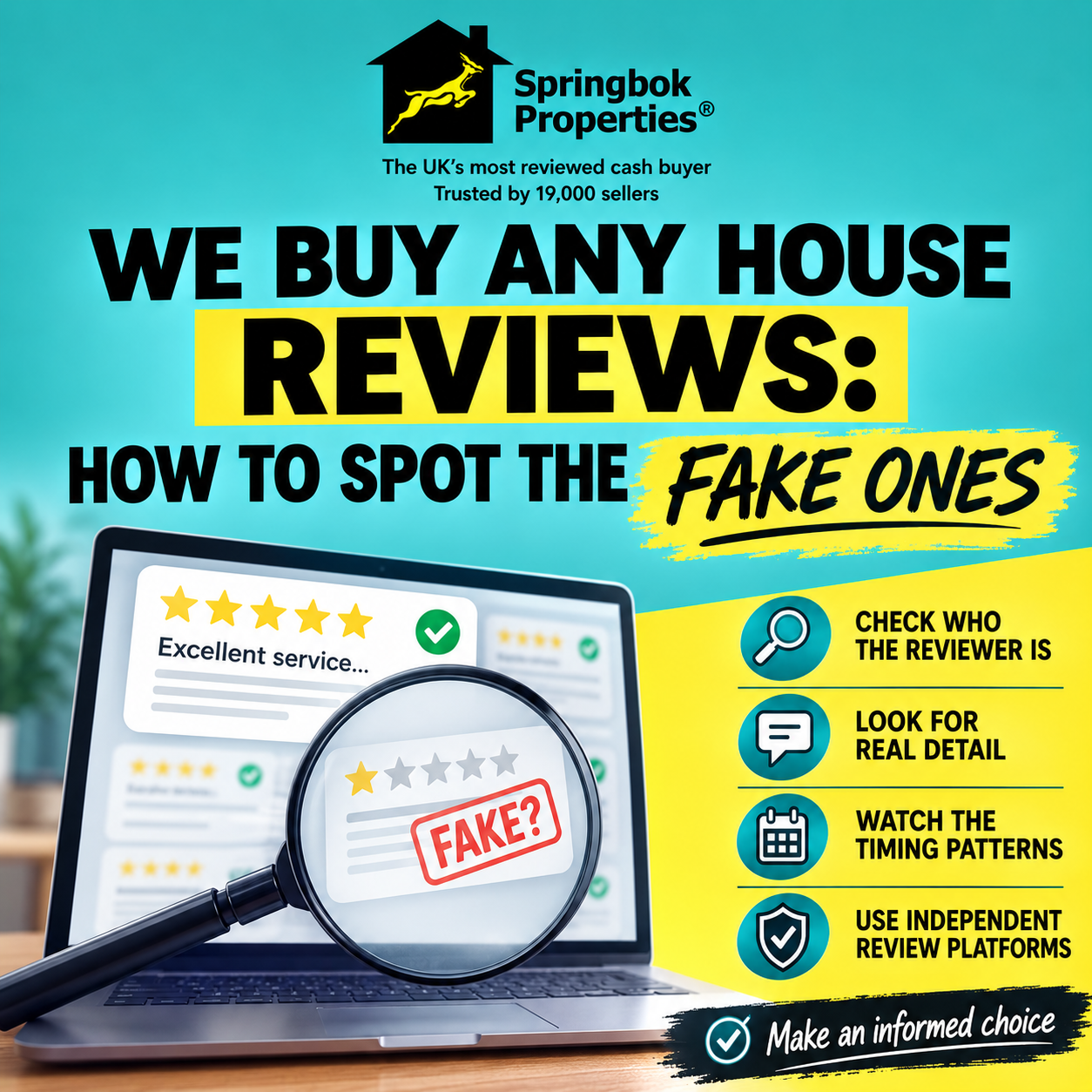
Fake reviews rarely fail on grammar. They fail on specificity and distribution. A real house sale generates details a copywriter would never invent — a lease extension, a probate delay, a boiler, a postcode. Here is what to look at, and what each signal actually means.
| What to check | Genuine profile looks like | Red flag |
|---|---|---|
| Detail in the text | Names the property type, the problem and the timescale (“short lease flat in Bolton, exchanged in 19 days”) | Generic praise: “great service, highly recommend, very professional” |
| Timing pattern | Reviews trickle in steadily, matching a firm’s completion volume | Twenty five-star reviews inside 48 hours, then silence for months |
| Reviewer history | Reviewer has other reviews across unrelated businesses | Single-review accounts, first names only, no location |
| Rating spread | Mostly 4–5 star with a visible minority of 2–3 star, answered properly | Only 5s and 1s, with nothing in between |
| Company replies | Specific, references the case, offers a named contact | Identical copy-paste reply under every negative review |
| Where it sits | Independent platform that verifies the transaction | Testimonials that appear only on the company’s own website |
| Language tells | British spelling, UK terms — freehold, exchange, completion | US terms such as “realtor”, “closing”, “escrow” or “$” |
One more test that catches most of it: read the negatives first. Planted reviews are almost always positive, so the 1- and 2-star reviews are where the real pattern lives. If the complaints all describe the same behaviour, believe them — even if they are outnumbered ten to one.
What do genuine negative reviews usually say?
Across the UK quick-sale sector, authentic complaints concentrate on four things. None of them is about rudeness; all of them are about money and timing.
- The offer was cut close to exchange. This is the sector’s defining complaint. In England and Wales nothing is binding until exchange of contracts, so a headline figure can be revised at any point before it — a practice known as gazundering. Read our guide to how much below market value cash buyers really offer for the arithmetic behind a credible offer.
- It was a broker, not a buyer. The seller’s details were passed to a third party and the “guaranteed” purchase never existed. A genuine buyer completes using its own funds and can evidence them.
- A tie-in was signed before the final figure appeared. Any agreement that locks you in, or charges a withdrawal fee, before you have a firm survey-backed offer should stop the process.
- The timescale slipped badly. A promised 7-day sale that took three months is a legitimate grievance. For context, roughly one in four agreed UK sales collapses before completion on the open market — which is exactly why speed and certainty are what a cash buyer is selling.
Several reviewers describing an offer reduced days before exchange, on the same company, is not bad luck — it is a business model. No star rating outweighs it.
Which review platforms are actually worth reading?
Not all of them carry the same weight. Verification — whether the platform can tie a review to a real transaction — matters far more than the volume of reviews.
| Platform | How much weight | Why |
|---|---|---|
| Trustpilot | High, with care | Publishes its removal figures and screens automatically; open platform, so anyone can post — check whether reviews are invited or organic |
| Google Business Profile | Medium | Hard to bulk-fake without detection, but no transaction verification and easy to filter by location |
| allAgents | Medium–high | Property-specific and moderated; smaller sample sizes |
| The Property Ombudsman | Highest | Not reviews — published decisions. A firm’s TPO record shows what happened when a complaint was tested independently |
| Company’s own testimonials | Low on their own | Curated by definition. Video testimonials with a named seller are stronger than text quotes with initials |
| Reddit / MoneySavingExpert forums | Useful context | Unfiltered and specific, but anecdotal and sometimes stale |
How do you verify a house buying company beyond its reviews?
Five checks, all free, all take about ten minutes. Reviews tell you how it felt; these tell you whether the company can actually complete.
- Companies House. Search the exact legal name at Companies House. Look at incorporation date, filed accounts and whether directors run a string of dissolved lookalike companies. (Springbok Properties Ltd is company number 09045757.)
- NAPB membership. The National Association of Property Buyers requires members to sign up to a code of practice and to independent redress. It is voluntary, not a regulator — but non-membership is worth asking about.
- The Property Ombudsman. Check the firm on tpos.co.uk. TPO membership gives you a free route to independent adjudication if the sale goes wrong.
- Proof of funds. Ask directly: are you buying with your own money, or introducing me to an investor? A funded buyer will answer in writing. If the answer is vague, you are talking to a broker.
- The paperwork. Read for tie-in periods, withdrawal fees, exclusivity clauses and whether legal fees are genuinely covered. If a company will not send terms before a valuation, that is the answer. Report suspected fraud to Action Fraud.
If you are weighing the route as well as the company, our comparison of a cash buyer versus an estate agent and the pros and cons of selling for cash set out the trade-offs. For shortlisting, see our roundup of the best house buying companies in the UK and the top 10 house buying companies.
How does Springbok handle reviews?
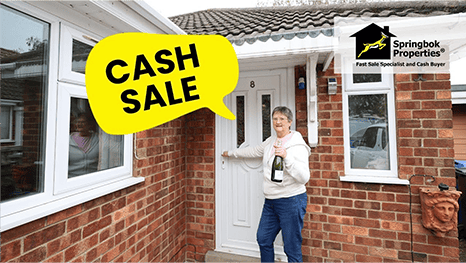
Springbok Properties Ltd is regulated by The Property Ombudsman and is a member of the NAPB. Our sellers review us on Trustpilot and allAgents, and the video testimonials above are named sellers filmed after completion rather than written quotes. We do not incentivise reviews — under the 2024 Act, doing so without disclosure is unlawful. You can read the fuller answer in is Springbok Properties legit? and are cash house buyers legit?
Frequently asked questions
Are “we buy any house” reviews reliable?
Partly. They are reliable for judging communication and speed, and unreliable as proof a company can complete. Read the 1- and 2-star reviews first, because planted reviews are almost always positive, then verify the company at Companies House, the NAPB and The Property Ombudsman before relying on any of it.
Are fake reviews illegal in the UK?
Yes. Since 6 April 2025, the Digital Markets, Competition and Consumers Act 2024 has banned submitting, commissioning or hosting fake reviews, and banned presenting incentivised reviews as unsolicited. The Competition and Markets Authority can fine a business up to 10% of its global annual turnover without first going to court.
How can I tell if a Trustpilot review is fake?
Look for missing specifics, single-review accounts, clusters of five-star reviews posted within hours of each other, identical copy-paste company replies, and American spelling or terms such as “realtor” or “closing”. Trustpilot removed 4.5 million fake reviews in 2024 — 7.4% of all reviews submitted that year.
Why do some cash buyers have great reviews but bad outcomes?
Because many reviews are left at enquiry or valuation stage, before exchange. A company can deliver an excellent first week and still reduce its offer days before completion. Weight reviews written after completion far more heavily, and check whether complaints describe a last-minute price cut.
What should I check before trusting a house buying company?
Five things: the legal name and company number at Companies House, NAPB membership, The Property Ombudsman registration, written proof the firm buys with its own funds rather than brokering your details, and the contract terms — specifically tie-in periods, withdrawal fees and whether legal fees are genuinely covered.
