
 Freephone 24/7 Call: 0800 068 4015












I'm a property expert that still remembers the days when having broadband was a selling point! My articles cover issues that homesellers face in the UK and answer the questions we're all asking. I've bought and sold properties and helped others do the same, so my writing comes from years of experience.
Read Full Bio >A cash sale is faster and certain but pays less; an auction can beat a cash offer on price yet guarantees nothing — 35.6% of UK residential auction lots went unsold in July 2026.
Key takeaways
- At a traditional auction the sale becomes legally binding at the fall of the hammer, with completion usually 20 to 28 days later — but the property only sells if bidding beats your confidential reserve price.
- Essential Information Group recorded 3,903 UK residential auction lots offered in July 2026 and 2,514 sold, a success rate of 64.4%, down from 69.6% in July 2025. Roughly one lot in three did not sell.
- Auction costs the seller 2% to 3% + VAT commission on the hammer price, an entry fee of up to about £500 + VAT, and £200 to £600 + VAT for the legal pack. A genuine cash buyer such as Springbok Properties charges the seller no fee at all.
- A cash sale from a principal buyer typically completes in 7 to 28 days at an agreed price that does not move, but the offer sits below full open-market value because speed and certainty are being bought.
- The modern method of auction is a third route: the buyer pays a reservation fee of around 4.5% + VAT (minimum roughly £6,000) and gets 56 days to complete, so it is neither as binding as a traditional auction nor as fee-free as it first appears.
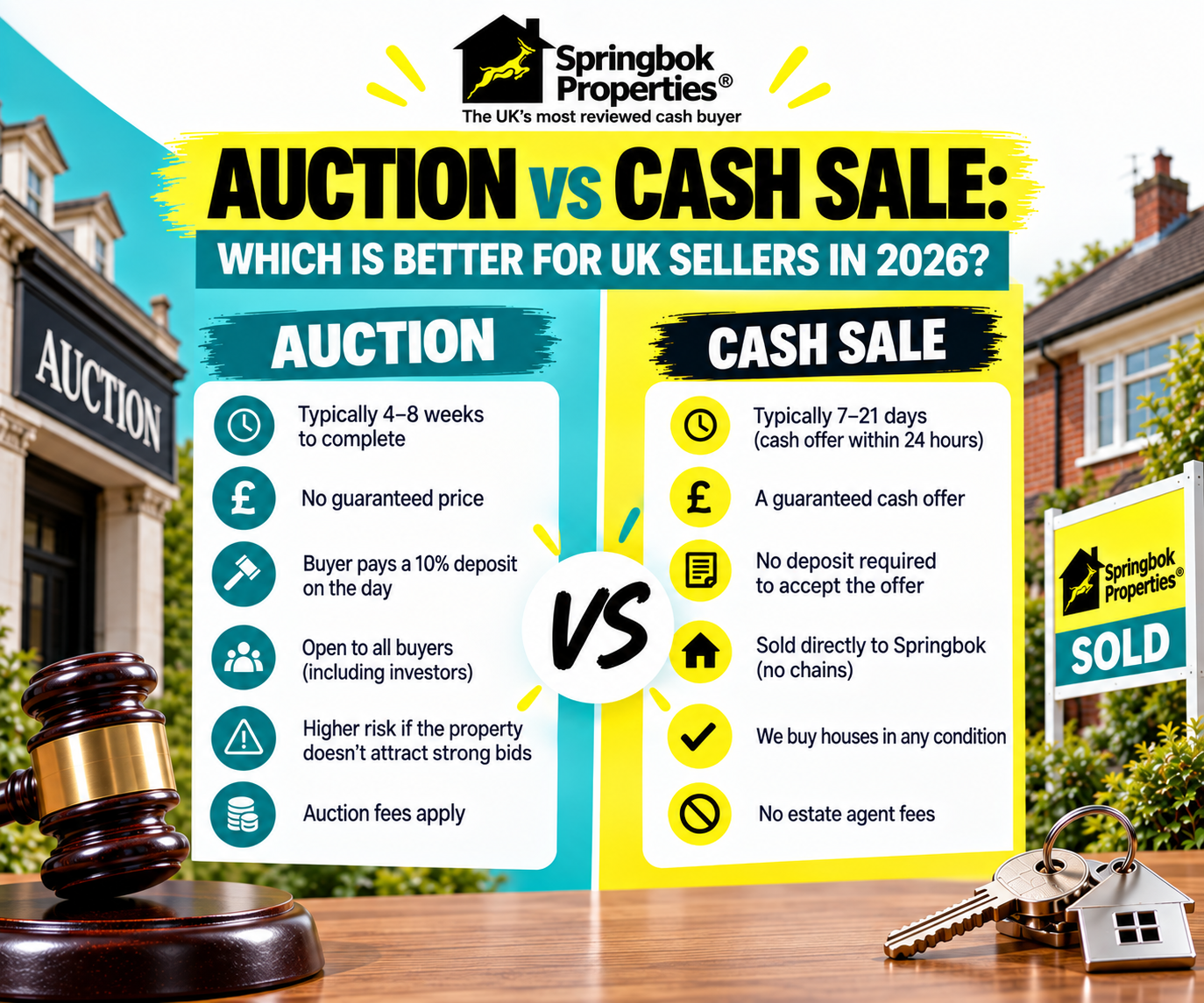
Auction vs cash sale at a glance
| Traditional auction | Direct cash sale | |
|---|---|---|
| Certainty of selling | Not guaranteed — 64.4% of residential lots sold in July 2026 (EIG) | Guaranteed once the offer is accepted and searches are clear |
| Time to exchange | 3 to 5 weeks of marketing, then binding on the day | Typically 7 to 21 days from acceptance |
| Time to complete | Usually 20 to 28 days after the hammer falls | As little as 7 days; commonly 14 to 28 |
| Seller fees | 2% to 3% + VAT commission, entry fee up to ~£500 + VAT, legal pack £200 to £600 + VAT | None with a genuine principal buyer — legal fees are usually covered too |
| Price achieved | Open bidding can exceed the guide price, or stall below reserve | Below open-market value, but fixed and known upfront |
| Can the buyer renegotiate? | No — contracts exchange at the fall of the hammer | Not with a reputable buyer; price-chipping is a red flag |
| Chain risk | None once sold | None — the buyer is chain-free |
| Best suited to | Unusual, unmodernised or investor-grade property with obvious upside | Standard homes where the seller needs a firm date and no surprises |
How does selling a house at auction actually work?
You instruct an auctioneer, agree a guide price (the marketing figure shown in the catalogue) and a reserve price (a confidential floor below which you will not sell, usually within about 10% of the guide). Your solicitor prepares an auction legal pack, the lot is marketed for roughly three to five weeks, and on auction day the highest bid above your reserve wins.
The moment the hammer falls, contracts exchange. The buyer pays a 10% deposit there and then and completion follows on a fixed date, normally 20 to 28 days later. That is the real appeal: unlike a private treaty sale through an estate agent, the buyer cannot renegotiate, cannot pull out, and cannot be lost to a broken chain. Around 24% of agreed UK sales fall through before completion — an auction sale, once it is sold, is not one of them.
The catch is the word if. Essential Information Group, the UK’s auction data body, recorded 39,635 residential lots offered and 27,268 sold in the twelve months to July 2026, raising just under £5 billion. That is a 68.8% success rate over the year and 64.4% in July 2026 alone. Auction gives you certainty about the date, not certainty about the sale.
What does it cost to sell at auction?
Auction is not the free option it is sometimes presented as. Expect three seller costs, and one you can trip over.
- Auctioneer’s commission — 2% to 3% + VAT of the hammer price, payable only on a successful sale. On a £200,000 sale at 2% that is £4,000 + VAT. Most auctioneers apply a minimum fee, often £1,500 + VAT or more, which matters on low-value lots.
- Entry or catalogue fee — £0 to £500 + VAT, charged upfront by most auction houses and non-refundable even if the lot does not sell. Some prime-location room auctions charge considerably more. It is often negotiable, and worth asking to defer it until after a sale.
- Auction legal pack — £200 to £600 + VAT. Your solicitor compiles title documents, searches, the property information questionnaire and any lease or tenancy paperwork. Note that in an auction the seller pays for the searches, whereas in an estate agency sale the buyer does.
- Withdrawal fee. If you change your mind after entering the lot, many auctioneers charge up to the full commission you would have paid. Failing to meet reserve on the day is different and usually costs nothing extra.
Add it up and a typical auction sale costs a similar amount to a good high-street estate agent — which is exactly the point sellers miss. If your reason for considering auction is to avoid estate agent commission, auction does not solve that problem.
How does a cash sale work, and what does it cost?
A genuine cash sale means selling directly to a company that buys with its own funds rather than a mortgage. You get a valuation, then a formal offer; if you accept, the buyer instructs solicitors and completes on a date you choose. There is no marketing period, no viewings, no chain and no lender to satisfy.
With a reputable principal buyer the seller pays nothing: no commission, no listing fee, no legal pack, and legal fees are normally covered. Springbok Properties is a member of the National Association of Property Buyers (NAPB) and is regulated by The Property Ombudsman (TPO), which is the baseline you should insist on — see our guide to whether cash house buyers are legit before signing anything.
The trade-off is price. A cash buyer takes on the risk, the holding costs and the resale, so the offer sits below full open-market value — how far below depends on condition, location and how quickly you need to move. We set out the real numbers in how much below market value cash buyers offer. A firm figure you can plan around is the product being sold, and any company that quotes a headline price and then reduces it near completion is not offering that at all.
Red flag to watch either way: a fee that appears late. At auction that is the withdrawal fee buried in the auctioneer’s terms; with a cash buyer it is a “survey adjustment” or admin charge introduced after you have committed. Ask for the full cost, in writing, before you instruct anyone.
Auction vs cash sale: which is faster?
A cash sale is faster, typically by four to six weeks. An auction lot needs three to five weeks of catalogue marketing before it can be sold at all, then 20 to 28 days to complete — around six to eight weeks in total, assuming it sells first time. A direct cash sale skips the marketing entirely and can complete in as little as seven days, with 14 to 28 days being the norm.
The gap widens if the lot does not sell. An unsold property is offered to underbidders for best and final offers, and if that fails it re-enters the next catalogue four to six weeks later — with the legal pack and entry fee already spent. For anyone working to a deadline such as a repossession hearing, a chain completion or a probate distribution, that risk is the deciding factor. Our guide to selling a house in 7 days covers what a genuinely fast timeline requires.
Which gets you more money, auction or a cash sale?
Auction wins on price for property with visible upside; a cash sale wins on net certainty for everything else. In an auction room the price is bid upwards by competing buyers, whereas in a private negotiation it is chipped downwards by one buyer with a survey in hand. Developers, landlords and owner-occupiers with renovation appetite will compete hard for an unmodernised house, a property with planning potential, a tenanted flat or anything unusual enough to be hard to value.
Where auction underperforms is on ordinary, fully modernised homes with no obvious angle. Those attract fewer bidders, often sell close to the reserve, and then carry auction fees on top. Compare the net figure — hammer price minus commission, VAT, entry fee and legal pack — against a fee-free cash offer before deciding, and factor in what an extra two months of mortgage payments, council tax and insurance actually costs you.
What about the modern method of auction?
The modern method of auction (MMoA), also called a conditional auction, is a hybrid and it behaves very differently from the traditional room auction described above. Bidding runs online for up to 30 days. The winning bidder pays a non-refundable reservation fee — commonly 4.5% + VAT with a minimum of around £6,000 — and then has roughly 56 days to exchange and complete, usually 28 days to exchange and 28 more to complete.
Two consequences matter to sellers. First, it is not binding in the way a traditional auction is: the buyer can walk away, losing the fee but leaving you back at the start. Second, buyers know they are paying that fee and bid accordingly, so it comes out of your sale price rather than the auctioneer’s pocket. HMRC also treats the reservation fee as part of the chargeable consideration for stamp duty, which further dampens bids. We covered the detail in is the modern method of auction a good way to sell?
When is auction the right choice, and when is a cash sale?
Choose a traditional auction if
- The property is unmodernised, unmortgageable, unusual or has development potential, so competing bidders will push the price above a private valuation.
- You can absorb the risk of the lot not selling and paying the entry fee and legal pack anyway.
- You want a binding exchange with no renegotiation, and a six-to-eight-week timeline is acceptable.
- You are selling a tenanted property to investors, where an income stream is an asset rather than an obstacle.
Choose a cash sale if
- You need a guaranteed sale on a date you control — repossession, probate, divorce, emigration or a broken chain.
- The property is a standard home with no renovation angle, where auction bidding is unlikely to exceed the reserve by much.
- You want zero fees and no upfront outlay, and you would rather take a known discount than gamble on a room.
- You do not want viewings, marketing or your address in a public catalogue.
There is also a middle path worth knowing about. Springbok offers both a fast cash purchase and a fixed-price open-market service, so the same property can be assessed for speed or for value before you commit to either — the comparison in cash buyer vs estate agent vs auction sets out how the three routes differ across price, time and risk.
Frequently asked questions
Is it better to sell a house at auction or to a cash buyer?
Auction is better when the property has renovation or development potential that competing bidders will pay a premium for. A cash buyer is better when you need a guaranteed sale on a fixed date, because 35.6% of UK residential auction lots failed to sell in July 2026.
How much do you lose selling a house at auction?
Seller costs are typically 2% to 3% + VAT commission on the hammer price, an entry fee of up to about £500 + VAT and £200 to £600 + VAT for the legal pack. On a £200,000 sale that is roughly £5,500 to £8,000 in total, similar to a high-street estate agent.
Can a buyer pull out after winning a property auction?
No. At a traditional unconditional auction contracts exchange at the fall of the hammer and the buyer pays a 10% deposit immediately. Under the modern method of auction the buyer can withdraw, forfeiting a reservation fee of around 4.5% + VAT.
What happens if my house does not sell at auction?
The auctioneer offers it to underbidders for best and final offers. If none is accepted, the lot can re-enter the next catalogue four to six weeks later. You pay no commission, but the entry fee and legal pack costs already incurred are not refunded.
Do cash buyers charge fees to sell your house?
A genuine principal cash buyer regulated by The Property Ombudsman and a member of the NAPB, such as Springbok Properties, charges the seller no fees and usually covers legal costs. Any company asking for an upfront valuation or admin fee should be treated with caution.
Is the modern method of auction the same as a traditional auction?
No. A traditional auction is legally binding on the day and the seller pays commission. The modern method runs online for up to 30 days, gives the buyer around 56 days to complete, and charges the buyer a reservation fee that typically suppresses the bids you receive.
Written by Dan Green, Springbok Properties. Last updated 6 September 2026. Springbok Properties Ltd is a member of the NAPB and regulated by The Property Ombudsman. Auction volumes and success rates are from Essential Information Group’s July 2026 residential figures.
